Tuesday, 18 January 2011

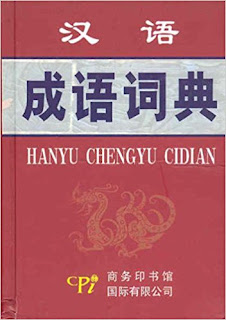
Chéngyǔ 成语

The Chinese language is rich in idioms, and although it is possible to converse in non-idiomatic standard Chinese, a foreign learner with only a superficial knowledge of Chinese idioms will be at a serious disadvantage in reading, and even more so when taking part in discussions. Apart from idioms, there are also the allegorical rhymes, onomatopoeia words, words from regional dialects, popular sayings, proverbs, and most importantly the literature—the vernacular and classical Chinese, that will catapult your language to the next level.

By idiom I am referring to what is called 成语(chéngyǔ) in standard Chinese. Like an idiom in English, we can define a 成语 as a combination of words with a special meaning that generally cannot be inferred from its separate parts. The Enlarged Dictionary of Chinese Idioms 中国成语大语词典 I have on my table here lists over 18,000 entries. Many 成语 but not all, are made up of four characters and for this reason the term is sometimes translated as 'a four character idiom.'

Let’s take a look at a two random examples:

1. 车水马龙 (chēshuǐmǎlóng). If we literally translate the idiom it means 'chariots, water, horses, dragons.' Clearly, it is rather difficult if not impossible to figure out this meaning from the separate words. In other words, the meaning of the whole idiom is different from its parts. The sentence has two meanings, a literal one, which means very little, and a metaphorical one which is the idiom. This idiom can be traced back to the Han dynasty when an empress described a stream of horses and carriages on a busy street: 'the chariots are like flowing water, the horses moving to and fro like dragons.' ('车如流水, 马如游龙').

If we bring the idiom to the present, it refers to an incessant or endless stream of cars—heavy traffic on the road, for example, or a scene crowded with people and vehicles. Compare: 人山人海 (lit: 'people mountain, people sea').

2. 见钱眼开 (jiànqián yánkāi). Unlike the first example, if we literally translate this idiom we can guess its meaning: ‘see money, eyes open', in other words, avaricious. Another example of a 成语 that we can pretty well guess its meaning if we read each character literally is 人生如寄 (rénshēngrújì): living in the mortal world is like a sojourner in a hotel, that is, life is short.

If you read the news whether that be that actual news print form (how old-fashioned is that?) or online, start collecting idioms. Many of them will be bookish idioms in contrast to colloquial ones, but keep an eye for one’s that keep cropping up in print as well as one’s your Chinese friends use.

Monday, 17 January 2011

The Language Adventures of René in China

In December last year, a large number of people contact me to ask who on earth is René and what exactly I was trying to achieve by writing 'The Language Adventures of René in China: Essential Expressions for Beginners, vol. 1.'


Below is part of the preface from volume 1 which should give readers a good idea of what I was trying to achieve.
-peter

Chinese language textbooks devote little space to explaining how the language is used in social situations or why Chinese people express themselves in such a way. This volume attempts to explain a number of greetings, common expressions, not to mention other speech acts, that will allow the foreign learner to understand the language better.

Why greetings and expressions might not be readily understood by foreign learners underscores the erroneous assumption that there are "equivalences" between languages. An equivalent of Ní hǎo can be found in the English "Hello" or "Hi", but there are numerous greetings and expressions that do not have equivalences in English.

Davies and Barmé have rightly pointed out this assumption 'presupposes the existence of a formidable metalanguage that has the capacity to match words, ideas, statements, and idioms across languages, according to some mysterious "law" or universal communication.' [1]

More than half a century earlier, the linguist and songwriter Chao Yuen Ren (1892-1982) expressed something similar:


Any utterance in an actual context can be translated fairly accurately, to be sure, but not necessarily by the same means of expression. Thus, the English phrase 'No, thank you!' can be translated more 'idiomatically' by a smile and a polite gesture than by the recent translation borrowing Duoshieh, buyaw le! [duōxiè, bú yào le 多谢,不要了] "Many thanks, I don’t want any more." [2]

The linguistic diversity of China and the large number of regional dialects that are mutually unintelligible to speakers from other parts of the country is aptly summed up in the popular saying 'speech changes every ten li' (shílĭ bù tōngyīn 十里不通音).

This saying highlights issues of comprehension among different regional speakers of the standard language or pŭtōnghuà (普通话) who may come across an initial 'impasse' or 'obstacle' (不通) when hearing standard Chinese spoken by dialect speakers, invariably coloured by local speech habits and accents.

For the foreign learner, accents and pronunciation do cause major practical problems, especially once they leave the classroom setting:


The great majority of Chinese speak standard Chinese with a dialectal accent, which may be so mild as to be scarcely noticeable or so heavy as to make normal conversation impractical. These accented speech variants are usually unknown even to advanced western students of Chinese until they arrive in China and find themselves experiencing much difficulty in communication. [3]

Each entry in this volume contains a common greeting or expression ‘acted out’ by a fictional character called René, a foreigner language student studying in Beijing whose course of study includes a part-time internship in a joint-venture market research company.

René encounters a number of difficulties in communicating with Chinese and makes a number of errors along the way, but he experiences an epiphany of sorts, a moment of understanding, where he realizes that he has expressed himself incorrectly or that a common expression in English finds a different medium of expression in Chinese.Numerous examples could have augmented each entry, but the challenge has been to condense the narrative to one or two pages and allow readers to grasp various aspects of the language quickly and easily.


References:


1. Gloria Davies Voicing Concerns: Contemporary Chinese Critical Inquiry (2001:xi).


2. Chao Yuen Ren Mandarin Primer (1961:50).


3. Liang, DeFrancis and Han, Varieties of Spoken Standard Chinese (1982:1).

Yang Yinliu and his Draft

Yang Yinliu (杨荫浏) wrote a critique of his Draft History of Ancient Chinese Music 中国古代音乐史稿 (hereafter Draft) in the April issue of Music Research (音乐研究) in 1958. It was more of a self-criticism. Yang wrote that he had a far-from-perfect grasp of Communist doctrines and that he had not become ‘proletarianized’ enough.

Yang started on the Draft in 1959 and completed two volumes by July 1977. The two volume work was officially published February 2, 1981. In 1965 Mao Zedong instructed that Yang's book be published without delay and Yang worked frantically to complete the text. At the time, Yang was reluctant to make any revisions, politically that is, and the book ended up on the printing press shelves for another ten years.

References:

Micic, Peter, 'Gathering a Nation's Music: A Life of Yang Yinliu' in Lives in Chinese Music (Helen Rees, ed), University of Illinois Press, Urbana and Chicago, 91-116, 2009.

Abing and the Webster Chicago Wire Recorder

When I was researching the life of Yang Yinliu 杨荫浏 at the Music Research Institute in Beijing almost a decade ago, I was always excited to see what I could dig up from the reference library and sound recording archive. Yang was among the first musicologists to experiment with recording musicians in their natural environment and many of his recordings made in the 1950s are held in the archive.

It was Stephen Jones who drew my attention to the Webster Chicago wire recorder used by Yang and Cao Anhe 曹安和 in their fieldwork recordings in Wuxi in the summer of 1950 and the six ‘legendary’ recordings of Abing 阿炳, three each for pipa and erhu, respectively.

Two of these recorders used by Yang Yinliu and Cao Anhe are housed in the Chinese Traditional Music Sound Archive at the Music Research Institute in Beijing. According to Wang Yusang, an audio engineer who works in the sound archive, two Webster recorders were brought back from Hong Kong by composer Li Huanzhi 李焕之 in 1949. I was able to view the two reels used to record the six works of Abing in 1950 from a computer screen in the archive. Wang also told me that more recordings could have been made, but the team of musicologists ran out of wire.

References:


Micic, Peter, 'Gathering a Nation's Music: A Life of Yang Yinliu' in Lives in Chinese Music (Helen Rees, ed), University of Illinois Press, Urbana and Chicago, 91-116, 2009.

Thursday, 13 January 2011

A Brief History of the Auto Industry in China

Another short piece from the auto archive, 2003-2004.
--peter

Ford Motors, GM and Mercedes-Benz set up auto plants in Shanghai during the Republican period. In 1902, Yuan Shikai bought a Mercedes-Benz from Hong Kong as a gift to the Dowager Empress Cixi. This vintage model is housed in the Summer Palace Museum.

China began to manufacture automobiles in 1955 with Soviet trucks, buses and tractors. The first commercial vehicle to roll of the assembly line was the 'Jiefang' (‘Liberation’) truck, manufactured by the Changchun No.1 Automotive Plant in 1956. The Plant started production Hongqi (‘Red Flag’) limousines, and a passenger car called Fenghuang (‘Phoenix’).


From the 1950s to the early 1980s, passenger cars were essentially the prerogative of China’s ruling elite. In the early 1990s, however, the Chinese government designated the automobile industry as one of the country’s so-called pillar industries making it easier for individuals to purchase motor vehicles.

In the 1980s, Steyr-Daimler-Puch (check this name), AMC Chrysler Jeep, Volkswagen and Audi had set up shop in China. U.S. component manufacturers Delphi, Ford, and Bosch soon followed. By the early 1990s, one million auto vehicles were rolling off the assembly lines annually. With China’s entry into the WTO in December 2001 the auto industry turned a new page. Foreign manufacturers were keen to grab a piece of the fastest growing auto market in the world. Sales of passenger cars soared from 750,000 units in 2001 to 1.2 million in 2002 and then nearly doubled to 2.1 million in 2003.

China's auto industry, however, was far from regulated. As Erik Eckermann writes in his book World History of the Automobile (2001): ‘

the auto boom of the early 1990s often generated chaotic conditions. High custom duties gave rise to organizations involved in smuggling parts and entire cars. Auto parts and dealerships sprouted in huge numbers, while a fragmented industry operated in an uneconomical and labor-intensive manner (p. 209).

Some 4.5 million cars rolled off the Chinese assembly line in 2004 making China the fourth largest producer in the world. By 2010, it is predicted that China will become the world’s number 2 producer after the USA.

Wednesday, 12 January 2011

Translating Modernity

Foreign translators, lexicographers and their Chinese assistants were a busy lot in the late nineteenth century. Their collaborative efforts and their contributions to modern Chinese lexicology were profound, yet who really remembers their works? Although their achievements seem nowadays to be little more than curios relegated to the shelves of archives or rare book collections in libraries, they provide a unique trajectory of how foreign terminology, including musical terms entered modern Chinese.


The bulk of texts written and translated by foreign missionary educators and their Chinese collaborators at the Tongwenguan in Beijing and the Kiangnan Arsenal in Shanghai included science, history, geography, geometry, chemistry, law and medicine. As the translation of these texts had to be rendered into acceptable literary Chinese that was beyond the capabilities of missionary scholars, an oral transmission of the original text was read to a Chinese assistant who then wrote it down. This procedure was no different to what Jesuit missionaries were doing two and a half centuries earlier and if we comb the earliest translations of Buddhist texts in China, we will find that this collaborative process has a long history.


In 1877, a trumpet manual published by the Kiangnan Arsenal titled 喇叭吹法 was the result of a collaboration undertaken by the American Baptist missionary Carl T. Kreyer and his Chinese assistant Cai Xiling. Cai could have chosen a phonetic transliteration for trumpet, but he used 喇叭 presumably because the Chinese instrument (which is also called 唢呐) share a similar curved-back flaring bell.


Wang Tao (1828-1897), one of the founders of modern journalism in China, used the word dānchún (单纯) a phonetic transliteration of the English 'dance' in his Jottings of Carefree Travels (1867) to describe 'men and women in western countries' moving about rhythmically in fixed steps or sequences to music. He writes:


In Western countries men and women assemble for what is known in their language as 'Dancing.' It can perhaps be seen as a survival of the Miao custom of dancing in courtship under the moonlight, as is still practised in Japan and other countries to the east. To the British it is a form of amusement. Each year in June and July big gatherings are held, and what a sight they are! A hundred, or perhaps two or three hundred handsome boys and girls, twelve to sixteen years old, are chosen from the town and partnered up by age. They are first taught the steps by a female instructor, taking months of practice to master them. Each of the various dances is named according to step and rhythm.


Liang Qichao's 'new-style prose' was imbued with vocabulary from Chinese Buddhism, Daoism, the Yijing (I Ching), and vernacular novels. He also favoured the Japanese variants, what are often called  'graphic loans.' The loans as Lydia Liu writes referred to 'classical Chinese character compounds that were used by the Japanese to translate modern European words and were introduced into modern Chinese.'


A transliteration like Wang Tao's 'danchun' and foreign loanwords expressed an allegiance to something 'new' and 'modern,' but transliterating foreign names and words was far from standardized. Liang complained of names ‘being translated in a hundred different ways by a hundred people.' Robert Morrison, Elijah C. Bridgman, William Milne and other Protestant missionaries grappled with attempting phonetic transcriptions as did many of their Chinese collaborators. If we swing the lexical pendulum in the other direction, foreign lexicographers of English-Chinese dictionaries in the nineteenth century found a number of Chinese terms for the one English word.


In Lobscheid's English and Chinese Dictionary (1867) the entry for 'school’ includes the following Chinese words:

书房 书馆 学馆 学房 学堂 学校

Each of the Chinese renderings of 'school' has slightly different shades of meaning. The word 学校 was reintroduced from the Japanese gakkō, but as Masini points out 学校 was already used by Mencius, employed by Guido Aleni in Zhifang waiji (Records of the Places Outside the Jurisdiction of the Office of Geography) in 1623 in Hangzhou and by Fan Shouyi in Shenjianlu (My Observations) ca. 1720 'to refer to the European school system.'


Liu Ching-chih describes the lack of uniform transcription rules in rendering foreign musical terms and names in the early twentieth century:


Most of the translations were for teaching purposes, especially during the first half of the 20th century during which there were practically no music text books on the development of European music, compositional techniques and aesthetics. In view of this, teachers at conservatories of music and university music faculties had no choice but to compile their own textbooks by rendering articles and books in foreign languages into Chinese...great difficulties were encountered in the work because:


1. names of musicians and musical terms and phrases are in Italian, Latin, German, French, Dutch, Spanish, Greek, English, Bohemian, Russian, etc;


2. translators form various parts of China favoured their provincial pronunciation and therefore it was difficult to arrive at uniform transliterations;


3. different foreign languages represented different cultures and different conceptual approaches might be required for the same term; and


4. the same terms in different periods of historical development might also have different connotations.


Let’s now have a look at some instruments rendered into Chinese taken from several texts in the late nineteenth and early twentieth century. These examples are taken from 'Appendix III' in my unpublished doctoral dissertation School Songs and Modernity in Late Qing and Early Republican China, Monash University, Melbourne, 2000.


1. 阿保笛 (oboe). Modern equivalent: 双簧管. Used by Xiao Youmei in ‘Introduction to Music '音乐概说', in 学报, no. 1, 1907.


2. 阿尔赓 (organ). Modern equivalent: 风琴. Used by Guo Songdao in London and Paris Diaries, 1876-1879 (伦敦与巴黎日记). 风琴 is used by Zeng Zhimin in ‘音乐教育论 (1904) and Xiao Youmei in '音乐概说,' 1907. Cf. 大筒琴 rendered as ‘European organ in Lobscheid English and Ch:inese Dictionary (1867, vol 3:1256).


3. 古拉料捏笛 (clarinet). Modern equivalent: 单双管. Used by Xiao Youmei in '音乐概说' 1907. Cf. 掂笛 in Lobscheid English and Chinese Dictionary (1867, vol 1, p. 395).


4. 洋琴 (piano). Modern equivalent: 钢琴. Used by Li Shutong in ‘Biographical Sketch of Beethoven,’ in 音乐小杂志, issue 1, 1906. Cf. 大洋琴 皮亚娜 披雅娜. 'Pianist' in K. Hemeling (1916: 1308) is rendered as 弹钢琴家and 大洋琴家. 钢琴 is used by A.H Mateer New Terms for New Ideas: A Study of the Chinese Newspapers (1913:70).


References


Hemeling, K, English-Chinese Dictionary of the Standard Spoken Language and Handbook for Translators, Shanghai: Statistical Department of the Inspectorate General of Customs, 1916.


Lobscheid, W, English and Chinese Dictionary with Punti and Mandarin Pronunciation, Hong Kong: Daily Press, 1867, vols. 1-4.


Liu, Lydia Translingual Practice: Literature,National Culture and Translated Modernity in China 1900-1937, Stanford: Stanford University Press, 1995:331.


Masini, Federico, The Formation of Modern Chinese Lexicon and Its Evolution Toward a National Language: The Period from 1840-1898, Department of Oriental Studies, University of Rome, 1993.


Mateer, A. H., New Terms for New Ideas: A Study of the Chinese Newspapers, Shanghai: Presbyterian Mission Press, 1913.


'Selections from Jottings of Carefree Travel by Wang Tao (trans. Ian Chapman), Renditions 53, 54 (Spring and Autumn): 2000, p 172.

To er or not to er

"One of the hotly debated questions of language policy is to what extent rhotacization should be adopted as a feature of the standard language. Many nonnortherners are unable to pronounce such forms correctly and avoid the –r suffix as much as possible, even in those cases where it serves to distinguish different grammatical categories: for huà huàr ‘to paint a picture', many southerners will say huà huà."

--Jerry Norman Chinese, 1988:145.


The title of this piece is taken from Dayle Barnes ‘To er or not to er’, Journal of Chinese Linguistics, 1977 (5):211-36. The following is adapted from Zhou Jian ‘眼与眼儿’in Zicizhongde quwei (Humorous Chinese Character and Terms) Beijing: Xin shijie chubanshe, 1999:193-195.


In standard Chinese, particularly in colloquial speech, words or morphemes undergo a phonological process called rhotacization [also known as érhuà finals] which refers to adding a suffix -r to the final syllables. Rhotacized (érhuà) finals do not exist in isolation. In pinyin romanization, the suffix -r is placed after the original final syllable and the character 儿 is added after the word or morpheme.

Q: Does it matter if words or morphemes are not in their rhotacized form?

A: It doesn’t matter if some words appear in rhotacized forms or not. But for others it is essential because they function to semantically differentiate words.

Q: Why does fànguăn require a rhotacized form and not túshūguăn?


-Guăn (馆) does not appear in a rhotacized form for grand, dignified public institutions such as embassies, art galleries, museums, cultural history institutes or organizations, exhibitions halls and hotels.

The suffix –r can be added to informal places such as restaurants (饭馆儿), pubs (酒馆儿) tea houses (茶馆儿), and cafés (咖啡馆儿).

Rhotacized forms convey diminutive overtones and objects considered cute or familiar. Usually, cock and rooster do not habitually appear in rhotacized forms, but by adding a final -r to a small chicken or chick
(小鸡儿) it conveys something loveable or endearing.

The suffix –r can also serve distinguish parts of speech as in the following:

gài 盖  'to cover' 
gàir 盖儿'cover'   

jiān 尖 'pointed'; 'tapering' 
jiānr 尖儿  'point'; 'tip'

Friday, 7 January 2011

Wind and Rain

The planning of the imperial capital Peking melded traditional philosophy, yin and yang cosmic forces, religious thought, ancient mythology, and cosmology expounded in ancient texts. The Jade emperor's celestial abode was populated by stars and constellations. There were originally four palaces corresponding to four cardinal directions: east, south, west and north. The Han dynasty historian and eunuch Sima Qian attempted to shuffle the celestial order of palaces by adding another called the Purple Palace (Zigong), its domicile being the North Star.

These five palaces adopted symbolic correlations of the five elements with cardinal directions and colors:

Wood (east, green)

Fire (south, red)

Earth (central, yellow)

Metal (west ,white)

Water (north, black)

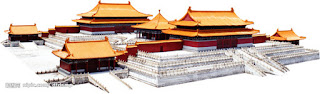
There were symbolic correlations with the number five such as musical pitches, stages of human growth and human virtues. Some of the symbolism had a significant impact on the architectural and spatial dimensions in city planning and the construction of palaces like those in the Forbidden City.

You can see yang odd numbers everywhere. Five and nine are especially potent numbers: the five-claw dragon, the five bridges. You'll see buildings divided into nine bays. The large gates with protruding bosses on them run nine across and nine down, nine being the most auspicious yang number and metonymy for the emperor. Dragons are virtually synonymous with the son of heaven, but in the Chinese cosmic scheme of things, there are actually nine. Nine also looms large in the music of the court. Numerous state sacrificial songs in late imperial China were composed with nine or less pitches and within the range of a ninth.

Dragons were also thought to control the wind and rain which is what fengshui means (literally 'wind and water'). Fengshui did not just refer to wind or rain but to cosmic or primordial energy which moved through the veins and vessels of terrains and winding watercourses.

Those gothic-like roof creatures that grace the eaves of the buildings in the Forbidden City--some of the figures appearing more than once and the number of creatures indicating the buildings' importance.The Hall of Supreme Harmony, the largest and tallest building in the Forbidden City and the first of the three ceremonial halls, has ten, not nine. 

I have always wanted to get hold of a book that would give me eyes to look at buildings. When I first visited the Palace Museum many years ago, I didn’t have the vocabulary to describe the buildings in which a surfeit of servants and their masters lived and worked. I am not an architect, but it has always been a hobby of mine to be able to read a building or a conglomeration of buildings like those in the Forbidden City. The stones in the Palace grounds can tell us much about the construction history, damage and reconstruction, extensions and repairs in times of prosperity and so on.

How does one go about reading something as gargantuan as the Forbidden City? The simple answer is to do it step by step. I could imagine spending a few days examining a cathedral in Europe, but the Forbidden City could take months. How to read the Forbidden City—it’s a book that needs to be written—would include examining the general orientation of the place, buildings and furniture, numbers and shapes, colours, construction, the roofs, columns, domes and ceilings, animal, bird and plant symbolism, and looking beyond the objects and images of the Palace to examine the history and symbolism of imperial dress, the ceremonial attire of the emperor, for example, or the dress of tributary envoys or the Mongol nobility.

Republican Blues

It was January 1912.The newly-formed Ministry of Education needed a national anthem for its new Republic. Letters were sent out to modernizing elites to start drafting suitably soul stirring texts.

A committee had read over three hundred submissions, but they were tossed out because there were not 'suitable.' It came down to the Republic's new boss Yuan Shikai to decide. He chose Song of the Green Clouds 'green clouds' being an ancient metaphor in Chinese for purity and loftiness. Choosing an anthem that would encapsulate the narrative of a new republic was not as easy as selecting the best stories of the nation or its best writers.

The new Republic was beset with factional fighting and local elites declaring their independence. Yuan never got the unanimous support to govern and when he died in June 1916 not before announcing that he would become the emperor in January, the country was run by warlord commanders and regional governors who carved out their own power bases. A number of national anthems circulated depending on who aspired to govern the nation. Yuan chose another anthem for the Republic in 1915 called China’s Strength and Power Strand Firm in the Cosmos. The epochal transformation from dynasty to republic is praised by none other than the mythical emperor Yao in the closing lines of the anthem.

Before the founding of the Republic, schools across the country had the own version of a anthem. Even the crumbling Qing Empire had its own anthem. In a diary entry dated September 28 1911, one of China’s pre-eminent translators wrote that he was off to the 'Imperial Qing Guard Public Office to decide on a suitable anthem.' Strengthening the Golden Bowl, was penned by Yan Fu, the aforementioned translator, and set to music by Pu Dong, a military training officer with the Imperial Guard. The empire would need more than an anthem to strengthen and unite the 'golden bowl' for within two weeks of selecting the anthem, the Qing Empire, and China’s last imperial dynasty, collapsed.

In setting a preexisting melody to a text, Yan and Pu adopted the models prescribed by the fashion of their time, but this compositional process went back much further, a practice that has its provenance in Chinese poetry. As early as the southern Song (1127-1279), it is recorded that poems were first chanted then set to a melodic line which became a song.

The process of taking 'old tunes and adding text' has striking parallels in liturgical and plainchants in medieval Europe. Contrafuctum which literally means 'to imitate,' 'to forge,' referred to the practice of a pre-existing melody set to a new text, a practice that continued well into the seventeenth century. The constant re-use of tunes, old and new and setting them to text—old and new—is so fundamental to Chinese vocal music that it barely needs to be called 'special.' We find it in narrative genres, revolutionary songs and in Chinese pop 'n' rock music.

In May 1921, Sun Yat-sen and the Nationalist Government in Canton issued their own anthem. Three years later, delegates to the First National Party Congress unanimously endorsed another new anthem penned by Sun Yat-sen and composed by Cheng Maojun performed as part as a cadet ceremony at the Huangpu Military School June 16, 1924. The anthem remains the national anthem of the Republic of China, Taiwan.

Before 'March of the Volunteers' became the official communist anthem after 1949 in mainland China, Mao Zedong’s arsenal of songs included Shaanxi folk songs set to revolutionary texts. There was no shortage of 'cultural workers'—left-wing writers, intellectuals, songwriters and folk singers that would turn Yan'an into hallowed 'red' ground and inscribe the Communist story in songs.

Wednesday, 5 January 2011

On Dr. Psychology

'I did a show some time ago on why married men cheat on their wives and what goes on inside the mind of the other woman. Today we are talking about the subject in China. I am joined by two young women who are writing books on extramarital affairs in China, one with me in the studio, the other online from Shanghai. Thank you for joining us today.' Thunderous applause from the studio audience.
'
'You told me Susan that the modern equivalent of the mistress in China translates literally as 'second breast.' A pretty graphic word I must say to describe a woman who cohabitates with a man but is not married to him. Susan brought to my attention something a Chinese netizen recently said about the differences between prostitutes, 'second breasts' and wives on an online forum. I’d like to share that with the audience and our home viewers.’

All eyes on a huge plasma television screen in the studio:

 Prostitutes are a bit like a paid public toilet, they’re there to fulfil a basic need and anyone who has the money can use them. An ernai [second breast] is like a private toilet – you need to be fairly well off to have one, no one else can use it, and you take much better care of it than a public toilet. And a wife? Well, you wouldn’t want to compare her to any kind of toilet at all, because she is your equal.

'From what I’m reading, says the doctor, 'I take it the taking on a lover or mistress in China, for those men who can afford it, is pretty common.'

'There’s plenty of talk of mistresses kept by wealthy Chinese elites,' intones Susan, 'the least being that they are idle women kept in gilded cages. Some are extremely rich, others are not. Some sign mutual agreements, while others are given broken promises. I’d love to be the fly on the wall when 'business'  is discussed or when the cock of the roost lays down the rules. What interests me and disturbs me at the same time is that it is seems to have become an accepted practice among certain men and women.'

'I’d like to pick up on your point of how prevalent it has become among China’s rich elite', says the host., 'but I’d like to bring in Rebecca in Shanghai to get some historical perspective on mistresses and concubines. Can you tell the nation about concubines in China, the antecedents of those second breast?'

There is a brief pause before we hear Rebecca.

'In imperial China', Rebecca begins, 'men could have several women though most men could only afford to have one wife. The Chinese graph for concubine describes the position of subservience, made up of two characters meaning ‘a woman who stands.’ Men’s wives were commonly called ‘rooms’ or ‘persons of the room’ and while she was not caged in the room 24/7 like some captive bird, a room had a particular connection to the husband’s wife, the bedroom where they procreated and had children.'

'Does that mean that men of means in China could have more than one wife?', asks the good doctor.

'If we turn back the clock to twelfth century China and earlier, a man was legally permitted to have only one wife,' continues Rebecca. 'Monogamy did not mean that a man could only have one woman, but it did mean that he could only take one wife. There were very strict legal codes at the time defining a wife and a concubine. So there a tradition of married wealthy men in China having other women, but I should point out, that it is a tradition that is obviously not unique to China. I’m thinking not just of concubines, but imperial harems in other cultures, the Eurasian empires, particular those of the Romanov empire in Russia and the Ottoman empire in Turkey as well as harems among the Mughuls.'

'Powerful men who kept harems as part of their conquests,' chimes in the host. 'What particularly interests me about harems is what strategies women used to cope and survive considering their circumstances.'

'You raise an interesting point there, if I may interrupt, says Susan, 'and one that does not really stray from our topic at all. Concubinage was—and is in China a highly lucrative avenue for some women, some receiving allowances from one or more men, as well as gifts like apartments, and cars as well as other perks. They can do what they wish with the money: spend it recklessly, invest it, or use it to start a business. Rebecca and I have a mountain of personal stories between us that we could share with your viewers, but I'm fascinated how open the topic is discussed among people in China and that if you are a married man or woman and you don’t have a lover on the side then something is wrong with you.'

'Yes, is does seem to be rare these days if two people can stay together and not be tempted to play around,' says Rebecca. 'There’s a joke here that everyone here in Beijing has a lover regardless of their socio-economic status, including those itinerant workers who collect the garbage.'

'When men or women tell me in America that there having an affair I never know how many people they have told the story to', says the doctor..

'After the break,' continues the host, 'we’ll talk to one Chinese mistress who waited six years for 'her man' to divorce his wife, but he ended up married someone else instead..'

Tuesday, 4 January 2011

The Bodyguard

I am assigned to be the emperor's bodyguard. It’s mayhem here these last couple days with the largest fall of snow in years and the attempted assassination on the emperor’s life by a group of palace ladies. They were cut up into bite-size pieces yesterday. A detective is on the case. The emperor’s mind is distracted. His thoughts piled higgledy piggledy in a vast mound.

Waiting for the water to boil, I watch the palace servants make up the emperor’s bed. The son of heaven is next door with his barber. 'My life has become one protracted ceremony', says the son of heaven. 'I’m sick of playing the emperor, weary of all the banquets, and tired of hearing those bells and drums. My doctors keep reminding me the importance of coitus reservatus in prolonging my health and longevity. Everything I do is minutely scrutinized including my sex life.’ All the emperor’s resentments are suddenly being projected on a huge billboard and he is convinced that everyone is in the know about it.

I am bodyguard-cum-retainer-cum-comrade-in-arms. I am also a eunuch. I had more balls cut off by one of the certified cutters in the city in my teens. I was given a narcotic herbal tea and my memory of that morning was that my penis and testicles were numbed using a paste made from hot chili peppers. I do remember the imperial cutter grabbing my genitals and then the wounds bandaged. I was not allowed to drink any liquids for three days.

We eunuchs get a lot of bad press. Most of us are illiterate. Some like me have climbed up the rungs of the imperial ladder to become stewards in the Imperial Household Department. Some of us meddle in politics, others feather their pockets by doing shady deals in antiques, treating the palace like it was their own imperial gift shop. And then there are the pyromaniacs.

Remember the last emperor Pu Yi? He had ordered his eunuchs to make an inventory of antiques in the Palace of Established Happiness, but an audit would reveal that many of the imperial treasures had vanished, sold off to buyers and dealers outside the Forbidden City. Eunuchs burnt the Palace of Established Happiness to the ground. Firefighters from the Italian legation came in to extinguish the flames. A foreign couple who were standing on the roof top of what is today Raffles Hotel witnessed the fire and spirited off to help. When they arrived the last emperor was covered in soot among the cinders trying to salvage his treasures.

Before I became a bodyguard my daily tasks included cleaning chamber pots, and getting up at some ridiculous hour to beat drums in the drum tower. There’s a lot of bullying among us—we are as stratified as the palace women. When we are punished we are usually beaten by a eunuch lower down the ladder. A eunuch that once served his master is now in charge of beating him.

But you know we are as different from each other as chalk and cheese. There was a historian, one of our finest .He offended the emperor and chose castration rather than death. I can understand that having your lower parts tampered with is better than being killed, but this guy argued that his castration could enhance his masculinity by pouring his energies into literary texts. For the emasculated scholar-official, the writing brush, as one contemporary writer puts it ‘was a substitute for the penis.’ Not having a phallus does not make us lesser men or heroes, but if things were different, I’d rather have my brush and my phallus as well.

The emperor has mounted his horse. He has just received a letter from one of his closest retainers. My job is to guard his body and mine.

References


Huang, Martin, W. Negotiating Masculinities in Late Imperial China , Honolulu, HI: University of Hawai‘i Press, 2006: 24.

Menzies, Grant- Hayter. Imperial Masquerade: The Legend of Princess Der Ling, Hong Kong: Hong University Press, 2008:132.

Rawski, Evelyn S. 'Palace Servants, in The Last Emperors: A Social History of Qing Imperial Institutions, Berkeley: University of California Press, 1998:162-166.